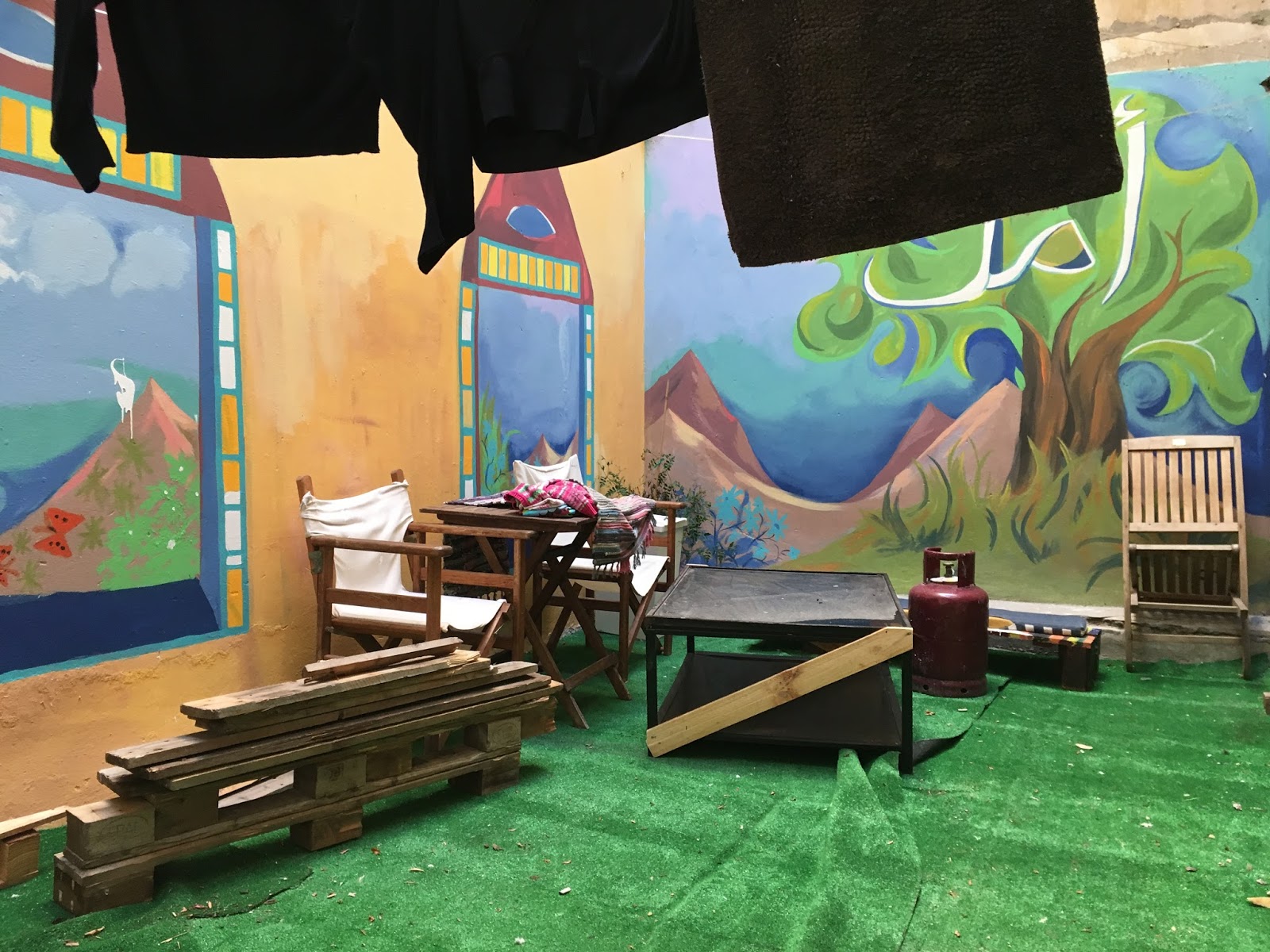
I seem to have found a bit of a new direction in life in that I've discovered how to spend time volunteering with refugee support projects in Europe. I started out with three weeks in Calais France in August/September 2016 and I'm following that with a stint in Greece Feb - April 2017, about which more later.
While in Calais I wrote a rough journal which I share below as the first post to my "Refuge in Europe" blog. I know some of you have already read this material - however, I've added photos here on the blog.
The Jungle camp was disbanded and demolished about a month after I left it, so my Jungle photos show a place that no longer exists. HelpRefugees continues to do just that in France and Greece.
Notes from Calais: Aug 15 – Sept 6, 2016
Day 1:
Date: Aug 15, 2016 9:57 PM
 |
Auberge de Jeunesse, Youth Hostel, Calais, France:
home for three weeks. |
Arrived safely, journey went well.
Youth Hostel is fine.
Made two nice friends both called Katy! I spent much of the day talking with
English learners from Sudan, Ethiopia, Syria and Afghanistan in one of the
schools in the refugee camp, because I don't start at the warehouse until
tomorrow.
Phone does not work so I have to communicate via email.
I will stay here three weeks.
Hostel is right by the sandy beach - looks nice!
|
Day 2:
My
first day working in the warehouse today. Sorting clothes and mostly packing
toiletries into "welcome packs"!
I volunteered for jobs that wouldn't tax my injured right wrist too
much.
The
place is phenomenal! It's a well-organized operation run by volunteers on a lot
of love and compassion and direct experience of people's needs in the
"Jungle" - yes, that's what the Calais refugee camp is called. It's
amazing to see how it all works, there's a lot of goodwill about.
 |
Photo not by me! Overview of part of the warehouse: clothes sorting.
There was much more, including a kitchen producing 2,000 hot meals daily.
Hygiene section is at top right of photo between two sets of shelves |
Day 3:
I wasn't certain before I came that I could do useful work
here, but I find that I can. It's a well-run organization, entirely volunteer
and the warehouse processes huge amounts of clothing, food and other donations.
They make hot meals for at least 2,000 people every day (population of the camp
is said to be over 9,000 people.) I'm
mostly working in the small "Hygiene" department; I volunteered for
that because it seemed possible given the limited use I have of my right hand
because of the still healing break of my right wrist.
We process, unpack and sort donations of toothbrushes, soap,
shampoo, diapers, and other toiletries. We make up "welcome" packs (a
bit it ironic, that!) that go out daily to refugees, and we keep a stock of
items that the "mobile distribution" teams can pick up when needed -
they go to various parts of the camp and find out what people need, then come
back with a list, load up and deliver the next day, so it's personalized, not
random.
There's also a growing collection at the back of our section
of items for "women's pamper day" (nothing to do with diapers) when
"luxury" items like perfume and make up, earplugs(!) eye masks and
hair gel are distributed: I don't know how that's managed.
Volunteers come and go: some are here for a day or a few
days, some for weeks or months. Everyone seems to be working hard.
Day 4: Morning
I have time to catch up today because I’m doing a later day
(10:30 to 7:30ish, probably) at Jungle Books again, Katy is taking me there for
the day.
 |
Katy drove me from my sister's house in Petersfield over to Calais.
She's staying t the Youth Hostel, too.
Katy's a qualified English teacher and took me to Jungle Books with her.
We don't take identifiable photos of refugees,
so I asked her to pose outside the Jungle Books library for me. |
Spent the day at the Jungle Books language school, which is
just on the edge of the big camp. Very intense, having consecutive
conversations with young men from Sudan, Eritrea and Iran. They are very keen
to learn so the initial approach is, from either one of us: “English?” (because
Jungle Books also teaches French), then “Are you here for a lesson?” because
there are “formal” lessons given by qualified teachers all day 11am – 7pm. If
not, then we get into student-guided conversation. Sometimes they have a book
they want to read from, some work sheets they’re going through or a particular
request like “phrasal verbs?” (whatever they might be!)
 |
| The entrance to Jungle Books. |
 |
| The Coptic Christian Church next door. |
So, gradually, I find out roughly what standard of English
they’re at and we settle into a conversation about weather, counting in
English, colors, telling the time or comparative adjectives. Time goes quickly,
I’m finding I usually spend 60-90 minutes per conversation. We may read a story
or a comprehension passage and then discuss that. Reading a traditional story from
some other country is a good prelude to asking the student to tell me a story
from his own country.
A good lunch is served during the day and a tea/coffee bus
visits near Jungle Books. It’s an independent church-run effort that turns up
every day to give out free hot drinks.
The toilets are Port-o-lets and not very pleasant.
 |
| Lesson at Jungle Books |
 |
| Evening conversation practice overflows onto dunes |
As evening approaches a lot more volunteers turn up and the
conversations overflow from the “classroom” area and the picnic tables onto the
dunes beyond. The camp is established in a large area of wild dune and scrub
land adjacent to the port of Calais where boats leave constantly for
England. The refugees are here because
they want to be on those boats.
Day 5
Back to the warehouse.
Worked in Hygiene. Started out with Laurel from Canada but
she went off to do something else. This happens often – people come and go.
Ended up working quite a lot with Sherry who lives in Cornwall but is from USA!
Ours is a North American section!
Day 6:
Walked out on harbor groyne this morning early. A long way
out. Must do it sometime when the ferries are heading out.
 |
| Sunrise in Calais |
Hygiene again. Far fewer volunteers at warehouse today –
Saturday – I was alone a lot of the day in Hygiene. People get taken away to go
into the camp to do things. Hope I get chosen sometime!
 |
| Hotel de Ville and giant blue snail |
Had to take bus home. We have to change buses at Theater,
but I walked the rest of the way because it’s down the main street, past Hotel
de Ville, quite interesting. It takes about 20 minutes if you don’t linger.
Day 7, Sunday August 21.
Decided today that Hygiene could do without me, so I started
off in dry foods instead. We make up packs of specific foodstuffs which go to
either two or five people for a week. Meals are often provided in the Jungle,
but having some supplies enables to people to cook for themselves if they wish to,
and can.
A bag for five people contains (as far as I remember):
3 cans tomatoes
3 cans beans
I liter cooking oil
One packet of cookies
Five onions
5 lbs. potatoes
50 black tea bags
250 grams sugar
Small bag of fajita spice
Small bag of salt
Sometimes a bag of rice
2 liters milk (this is the UHT type that doesn’t require
refrigeration until opened)
I believe we send bags out every day except Sunday, to
different people. I don’t know half of what goes on here, I’ve only scratched
the surface in the week I’ve been here.
Met a man from Brattleboro, VT today. He spends 9 or 10
months every year on volunteering like this. He’s working in the wood yard
where scrap wood, like pallets, is cut up into firewood lengths for refugees in
the Jungle to use.
 |
| Clothes sorting |
In the afternoon I helped sort clothes. Many tons of
clothing are donated but only a fairly small
 |
Scale for measuring donated clothing
(you can't trust the manufacturer's sizes!) |
proportion of it is actually sent
into the camp. The rest goes to other
charities. This is because needs are very specific. Of the 9000+ people in the
Jungle, more than 8,000 are men, mostly young men. A lot of women’s and very
large men’s clothing is donated, and not needed. Also, we send only clean
clothing in good condition into the camp, because it’s considered disrespectful
to offer people stained, frayed, damaged or broken clothing.
Pretty tired at the end of the day, and I’ve developed a
cold. I’m going to take tomorrow, Monday, off, for a rest, laundry, get some
cold medication and take stock. Beginning to cast out feelers about traveling
back to UK around Sept 6, as I have nothing organized so far.
Day 8, Monday Aug 22:
I took a DAY OFF! Sorted various things, bought food, got
myself a French cellphone so I can now talk to my family in US and UK!
Day 9, Tues Aug 23
 Back to the Warehouse. Volunteered today to help sort
children’s clothing. We’ve had far too much donated and we’re boxing it up to
go to a sister warehouse in Greece, where there are a lot of refugee children.
The Jungle in Calais has a very small proportion of children – must be less
than 5% of the 9,000+ inhabitants. There are many more in Greece.
Back to the Warehouse. Volunteered today to help sort
children’s clothing. We’ve had far too much donated and we’re boxing it up to
go to a sister warehouse in Greece, where there are a lot of refugee children.
The Jungle in Calais has a very small proportion of children – must be less
than 5% of the 9,000+ inhabitants. There are many more in Greece.
We had a really good team, lots of fun and cooperation as we
checked, sorted and boxed endless piles of kids’ clothing. The camaraderie is
high in a situation like this.
Today I changed my room at the Hostel: my previous lovely
room-mate, Katie, was heading back to Edinburgh, and I’m now sharing with Ruth
from London who seems lovely too – she’s just gone off for a swim!
Day 10, Weds, Aug 24
Went back to sorting children’s clothes for Greece because I
thought it a good idea to progress that project. Good team again but still a
mountain to get through!
Very hot (high 80s F I should think), but OK in the lofty
warehouse. I have a cold and a cough so
not feeling 100%, but the day passed quickly anyway.
Did I mention lunch? It’s served to volunteers every day and
is good rice and a vegetarian dish and a chopped salad. Same as the 2,000 meals
that go into the camp!
More communication frustration this evening as my new French
cellphone is out of minutes. I don’t know how that happened: I thought I had
made only toll-free calls, but what do I know about such things?
Day 11, Thurs Aug 25
More kids’ clothes sorting. A word about warehouse
organization: Help Refugees is an all-volunteer organization as far as I can
see. There’s a constant turnover of volunteer staff in the warehouse, some
people staying only a day or two, some for many months. Information and instructions are passed from
person to person. There’s a cohort of
perhaps 20 longer-term volunteers who wear orange high-visibility vests instead
of the yellow ones the rest of us wear, and they are the go-to people. So, if I
have a question, I find “an orange” to ask! “Oranges” also change from time to
time.
Another new room-mate: Georgia from London. We’re working
for a British organization so the volunteers are mostly British although there
are also Spanish, Portuguese, French, German, Dutch and other
nationalities. Most of the people in the
Jungle are there because they wish to seek asylum in the UK, so many Brits feel
that the situation in Calais is a British problem and they are very angry with
the UK government for not doing more to help.
Internet in hostel is not working. Feel very cut-off!
Day 12, Friday Aug 26
 |
Here's the van I drove,
parked outside the mosque in the middle of the Jungle.
I waited with the van while the team made deliveries. |
I finally plucked up courage to volunteer to drive! So I
drove an ancient Ford transit van (on the right because this is France, with
the steering wheel also on the right because it’s a British vehicle!) into the Jungle, with the kitchenware team.
They visit refugee tents and find out what people need in the way of cooking
pots, plates, etc., make up an “order”, identify the recipient by tent number
and take a mobile phone number if possible, then go back to the warehouse, make
up the order and a few days later take it back into the Jungle and attempt to
deliver it. We took about 20 bags of donated kitchenware to deliver in the camp
today and managed to track down about 15 recipients. The others we just
couldn’t contact. We’ll try again
Sunday, and also take some more deliveries then.
 |
| Regular clothes distributions happen here |
 |
These new arrivals have picked up sleeping bags
from the welcome caravan (caravan = trailer in British) |
I had to drive very slowly through the Jungle. It’s a maze
of tents of all kinds and people don’t get out of the way of vehicles very
readily. First gear most of the way! There are small shops and restaurants run
by refugees as well as distribution points and kitchens run by non-profit organizations;
there are schools, mosques and at least one church, too.
We had deliveries on board for specific people, but others
would come to see what we were giving out, and maybe place an order. One member of our team spoke French and one
Arabic in addition to English, but still communication could be difficult
because some of the refugees understand none of those languages.
Day 13, Saturday August 27, 2016
Plan is to go to Jungle Books with Katy today at noon.
I managed to get onto the Internet at the Tourist Office in
town for 20 minutes this morning and get some important work done!
At Jungle Books I talked with groups of young men from Sudan
and Afghanistan, one from Chad and one from Pakistan. They’re all different and
all anxious to learn English. One group of six Sudanese spent about two hours
with me exploring the past, present and future of English verbs and asking one
another questions like: “What are you doing today?” and “What will you do
tomorrow?” They seemed to enjoy it.
I also spoke with two men from Afghanistan. One spoke quite
good English, one very little. I really felt for the older one, 26, who spoke
little English but seemed to be a well-educated and respected man as evidenced
by his friend’s attitude toward him. It must be very hard for a man like that
to become a beginner again, learning to say “My shirt is white” and “Your hat
is red” among scrabbled-together buildings in a dune field in France.
After work Katy and I and several other volunteers walked
into the main camp – just five minutes away, to go to a restaurant for dinner.
Yes, in this impromptu community of 9,000 souls there are shops and
restaurants. We went to Welcome Restaurant, run by an Afghan man called
Hafiz. We sat outside around tables on
an elevated platform and watched the sun set over a small lake immediately
beside us. It was strangely beautiful and incongruous. The food: shared plates
of cooked spinach, eggs, rice and beans eaten with unleavened bread, was
delicious and the sweet chai served after the meal was marvelous.
I’ve felt better these past two days – did you realize that
I was feeling a bit tired and depressed? Maybe it’s because my cold has passed over,
leaving just a nasty “Jungle cough” behind – most people with coughs here
attribute them to the dust blown up in the Jungle – or it may be because of the
change of work – out of the warehouse into the real word of the camp. I almost
gave up and decided to come home with Katy September 1, but I’ve reconsidered
and I’ll stay, as originally intended, until Sept 6 – it’s a short enough time,
anyway.
Day 14, Sunday August 28, 2016
Good news today is that the truck for Greece arrived and
filled up yesterday so all the children's clothes we sorted, plus many more
items, are on their way to refugees in Greece!
Drove another delivery for mobile distribution today,
kitchenware again. This time we took 26 bags into the Jungle and distributed 21
to their intended recipients, which is a really excellent achievement.
 We parked for much of the time outside a Mosque beside an
operation called Kitchen in Calais. The proprietor came out to talk to me as I
stood guard by the van. He is a retired Malaysian engineer who lives in
England. He and his wife came to volunteer in the Jungle for a week and have
stayed so far 11 months. They saw a need and set up a food operation –
non-profit, using donated food and money to serve up to 1500 hot meals a day,
and sometimes an afternoon snack as well, said Jamal’s wife, Sophinee (Names
approximate) who told me a lot about her family: their three college-age
children are at home in the north of England, while the 13-year-old is living
and learning with his parents in the Jungle.
We parked for much of the time outside a Mosque beside an
operation called Kitchen in Calais. The proprietor came out to talk to me as I
stood guard by the van. He is a retired Malaysian engineer who lives in
England. He and his wife came to volunteer in the Jungle for a week and have
stayed so far 11 months. They saw a need and set up a food operation –
non-profit, using donated food and money to serve up to 1500 hot meals a day,
and sometimes an afternoon snack as well, said Jamal’s wife, Sophinee (Names
approximate) who told me a lot about her family: their three college-age
children are at home in the north of England, while the 13-year-old is living
and learning with his parents in the Jungle.
Sophinee said that they really need long-term volunteers,
people able to stay at least a month, to learn how to prepare the meals. They
mostly need strong people because the work is quite heavy. They have accommodation right there in the
kitchen compound. It sounds to me like a really good volunteer opportunity.
Today they were cooking chicken curry and rice for 1500.
Link to article about these people:
http://www.independent.co.uk/news/world/europe/refugee-crisis-calais-migrant-camp-asylum-seekers-france-how-to-help-malaysia-couple-a7216716.html
In the afternoon the “mobile distribution” team loaded up
the van with large bags of household goods, everything from toothbrushes and
matches through prayer mats to sleeping bags and large water containers. Everything
was sorted into bags for specific recipients. I drove it to the camp, with two
companions. The rest of the distribution team were coming in the minibus.
We always have to stop at a police check point as we drive
in; the other two times I did this they just asked for our permit, looked
briefly in the back of the van and waved us through. This time, in addition to
the permit and my ID/driver’s license, they asked for the vehicle’s papers. We
looked, but there were none.
So they made us unload the entire van. Underneath all the
bags were three small wooden pallets and two small sheets of chipboard which
were intended for making beds. These, the police officers decided, were
“construction materials” which we were not permitted to take into the camp. They
confiscated them and denied us entry to the camp because of this and because of
not having the vehicle papers. We returned to the warehouse and filled out
incident forms. A different van and driver will take the delivery, minus
pallets, to the camp tomorrow. It was frustrating, but I can’t help thinking
that we were lucky not to be fined for not carrying registration papers –
that’s what would happen in the USA, after all!
I don’t know if the
people who loaded the van knew about the prohibition on construction materials
–apparently the rules change with the wind, especially on weekends – but I hope
they don’t try that again! Most of the police officers were perfectly courteous
although the one in charge was a bit truculent and spoke rather aggressively,
which wasn’t necessary as we were perfectly calm and compliant. My companions,
Sarah-Louise and Rebecca, very cleverly took down the badge numbers of a couple
of the officers so we could identify them in our incident report.
Lauren, the team leader, later apologized to me for the
presence of the pallets, so I guess they knew their presence might cause
trouble.
Following photos are views of Jungle accommodation.
Day 15, August 29, 2016, beginning of my last week here.
Still not sure how I’m getting back to England!
More of the same with the police today! I drove a larger
van, with less stuff in it, for kitchen delivery. Visited Jamal and Sophinee
and saw the inside of their Kitchen in Calais – impressive – such dedicated
people!
After distribution, on the way out, we were stopped at the
checkpoint because one of my passengers hadn’t fastened her seatbelt!
AAAArgh! It was a situation where the
police were looking for a reason to stop you so that they could look for other
infractions. It was the same police officer in charge as yesterday. They looked
at our documents, looked in the back of van – mostly empty – asked for our
emergency red triangle which vehicles are required to carry (we had it), looked
at the vehicle documents and decided that one document was not correct because
part of it was filled in in ink instead of having been printed out and that the
photocopy of the insurance we had in this (rental) van should have been the
real thing. At least we had accomplished our task and were on the way out.
The fine for the seat belt infraction and document
irregularities is apparently 300 Euros. No physical ticket was issued. We don’t
know whether it will actually be levied, or whether anything else will happen:
lawyers working for our charity organization have taken all the details and
will go from there. Apparently the particular police officer who conducted both
the stops I was involved in has stopped several vans in the past few days.
Of course the police need to keep an eye on vehicles going
in and out of an unofficial 9,000-person camp, but the two stops I’ve been
involved in seem rather petty. I’m hoping I’m not jinxed! I’ll try again
tomorrow if they let me.
The police patrolling the port and guarding the entrances to
the camp are not local Calais police, but CRS, which is a special branch of the
French national police trained in riot control and other emergency work.
Came back to hostel early and – oh joy! Internet is working
again. I seem to have found a lift back to England Sept 6.
Day 16, Tuesday August 30
I drove into the Jungle camp three times today: once for
kitchenware distribution, once just into the southern part of the camp for
distributing supplies to two schools and a few other people, and the last time,
quite late in the day, to pick up some clothes that had not been distributed
because of a disturbance in the camp.
There was a stabbing in the afternoon: apparently it was part of the
continued unrest between the Afghani and Sundanese communities here. One of our
distribution volunteers administered first aid. I haven’t been able to find
many details, although I did talk with two of the team involved, but not
present at the incident, when I drove them in to collect the clothing they
hadn’t distributed. Ambulances don’t
come actually into the camp, so when the paramedics arrived they came in on
foot, leaving the ambulance outside. I have not heard that the victim died.
We had no trouble with the CRS at either entrance to the
camp today.
Day 17, Wednesday August 31, 2016
Two of our vans are now off the road because the CRS has
found fault with their documentation, one other van has a broke windscreen and
one went to Lille to collect vegetables, so there was no vehicle for me to
drive today! Volunteers with cars drove the mobile distribution teams into the
camp. One team of volunteers had their personal bags searched by CRS.
I was at the warehouse all day sorting clothes. It’s quite
tiring, but not unpleasant and the time passes quickly.
The whole situation around the Jungle has been a continuing
problem for the town of Calais, and the French and UK governments for many
years now. The firsts migrants set up camp on this dune field and former
landfill beside Calais’s very busy channel port in 1999. The crossing from
Calais to Dover is the shortest route across the English Channel, only about 20
miles. Calais is also the French terminus of the Channel Tunnel. I’m sure you
can Google the whole history of the place if you want to know more.
Day 18, Thursday Sept 1.
Today I witnessed something I’d seen only on video before,
something made me feel very sad and distressed.
I was working in Jungle Books with a Sudanese student when
we heard a noise in the distance which soon resolved itself into police sirens
and people shouting. We left the Jungle
Books compound to see what was happening.
We were in an area of the Jungle which is open dune land –
that’s because all the refugee dwellings on the south side of the camp were
demolished in March by the French government, leaving only schools and
churches. So we walked out and toward the main camp. That means we were looking
directly at the AutoRoute (Motorway, Interstate) about 75 yards away, which
takes vehicles to the port, to the ships to England. That’s why the camp is
here: people are trying to get on those ships. The AutoRoute is now fenced with
double ten-foot-high wire fences topped with razor wire. I’m told the fences
were paid for by the British government.
Some photos of the fences, taken from the main road,outside the Jungle:
Apparently, whenever the traffic stops on the AutoRoute,
when there’s a traffic jam, which is rare, refugees try to board trucks. It
usually happens at night but this was broad daylight.
As we walked toward the AutoRoute bridge I saw smoke and
smelled what I thought was tires burning. A group of about 20 men ran away to
our left toward the fence, away from the police cars. “They have wire cutters”
said my companion. The men clustered at
the fence and soon I saw some of them running on the AutoRoute and climbing
onto trucks. All this time, several police (CRS) cars and vans were clustered
at the AutoRoute flyover directly ahead of us.
 |
| Tear gas canister: my foot for scale |
I saw men running both ways on the AutoRoute, and then some
back to the camp. I saw police cars catching up with them and I saw several of
the refugees climbing up on top of the big container trucks and being driven
away as the traffic jam cleared. The
smell was tear gas, which made me back up a bit! Just a whiff of that is enough
to send you running! Some canisters were set off just upwind of the group of
men at the fence; it drifted to them and they ran back into the camp.
It was very moving to see this group effort among people who
knew that maybe only a few, or one or two, or none of them would actually
succeed in getting through the fence, onto a truck, onto the ferry and off onto
UK soil. The people in the camp,
including me, just stood and watched, a little bit excited but mainly calm,
some rooting for the escape attempt.
I wondered, also, what the truck drivers were doing. Did
they know that they had refugees on top?
The word in the Jungle is that about 10 refugees a night -
or I've also heard 200 a week - actually get across to England by stowing away
on trucks. I asked some of the men how they knew that people succeeded and they
said that the successful ones called from England. Some men try every night.
That's why the camp is so quiet in the mornings - they work nights trying to
board trucks, and sleep in the mornings.
Day 19, Friday Sept 2:
Quiet day at the warehouse today sorting clothes. I was
asked to make up some special orders for named women and children in the Jungle.
Tried to pick out the best items I could: I hope they fit and the recipients
like them!
A little rain this evening. It’s mostly been fine since I’ve
been here.
Day 20, Saturday Sept 3:
New roomie Nicole from London arrived at 12:30am!
Spent the day in the warehouse sorting clothes again. MP
(Member of Parliament – that’s like a Congress person) Stella Creasey (Labour -
Walthamstow) visited with an entourage and donations and I spoke for a while
with some of her group.
Midwife Vanessa told me about new age communities in Orgiva,
Spain, and I spoke at lunch with a volunteer who’s been here nearly a year, a
traveler man who does a lot of the plant engineering work for the warehouse. He
takes a very paternal attitude to the whole project. He spoke about how easy it
is to travel around and just sleep in a hammock on building sites! Both of
these conversations make me want to become a traveler! I mean one who travels
as a lifestyle.
Day 21, Sunday Sept 4.
 |
| Me as an orange |
I was elevated to orange status today! Guess I’ve been here long enough that they
think I know the answers to some questions!
Sorting clothes all day. Everyone is wondering what will
happen tomorrow. We’ve been asked to arrive at the warehouse before 9am, then
they’ll close the gates and doors that usually stand open. They’ve asked people
not to bring donations tomorrow. Help
Refugees will serve hot food in the Jungle at lunch time as usual but, won’t
distribute clothing or anything else tomorrow.
Met Ramona, an artist from Glastonbury
Day 22, Monday Sept 5
We kept a low profile at the warehouse. There were more
volunteers present than usual as those who usually go into the camp stayed
“home” and we were joined by a few volunteers from other organizations who
decided not to go into camp today.
I’m sure the blockade caused problems for motorists and
hauliers traveling across the Channel, but it was much smaller than expected.
Our minivan, driven by volunteer Paul, bringing in some volunteers in from one
of the campsites was accosted by demonstrators and forced to turn around. They
drove in by a different, longer, route.
The same van was also prevented by demonstrators from entering the
Jungle, but, again, they found a different route in.
Ramona cooked dinner for us in her van this evening.
Day 23, Tuesday Sept 6
My last day at the warehouse, sorting clothes again.
Ironically a couple of opportunities for me to go into the Jungle to work today
and tomorrow opened up but I had to decline them. So I’ve spent my last five
days here sorting clothes in the warehouse!
Drove back to England via Eurotunnel in a Land Rover with
Donna Leech and five other people.
 |
| Inside the Eurotunnel train. |
The cars drive onto a train and are
transported under the Channel.
Unfortunately our train was 90 minutes late because of an accident, so I
didn’t get back to Petersfield until 11:30pm.
So, that’s the end of the Calais adventure.
I’ve learned a lot about life in the Jungle and about the
refugee situation in Europe in general, and I’ve come home intending to engage
in some way with the many refugees who have settled in Burlington.
The End